




Salam! This is Sugi from ASHU TRAVEL, your guide to the stunning landscapes of Central Asia.
This time I’m introducing Uzbekistan, a country I visited myself and personally found as lively as “the Osaka of Central Asia.”
Here’s the essential information you need before your trip!
What Kind of Country Is Uzbekistan? The Basics

For those who say, “I’ve heard the name, but what’s it actually like?”: Uzbekistan is an energetic country where a history of flourishing at the heart of the Silk Road coexists with the lively atmosphere of a “merchants’ town.”
About 1.2 Times the Size of Japan!
Uzbekistan covers an area of about 447,400 square kilometers.
- About 1.2 times the size of Japan.
- Much of the country is covered by the Kyzylkum Desert, but in the east, branches of the Tian Shan mountains rise up, bringing lush greenery and rivers.
If Kazakhstan is “the world’s largest landlocked country,” Uzbekistan has an even rarer geographical feature: it is one of only two “doubly landlocked countries” in the world (countries from which you must cross two other countries to reach the sea).
Population of About 37.03 Million, the Largest in Central Asia!
Uzbekistan has the largest population of all the Central Asian countries.
- The population is about 37.03 million (2024 estimate).
- With so many people, the streets and bazaars (markets) are always bustling with energy.
The Capital, Tashkent, Is a Modern Metropolis
The capital of Uzbekistan is Tashkent.
- With a population of about 3,048,000, it is the largest city in Central Asia.
- Rebuilt after the major earthquake of 1966, it’s a big city with wide streets, modern buildings and a beautiful metro.
- It has a sophisticated charm that’s quite different from the ancient “blue cities” such as Samarkand and Bukhara.
Where Is Uzbekistan?
Look at a map and you’ll see it’s right at the heart of Central Asia!
- It borders Kazakhstan to the north, Afghanistan to the south, Kyrgyzstan and Tajikistan to the east, and Turkmenistan to the west.
- Since ancient times, as a key hub of the Silk Road, it has served as a crossroads connecting East and West.
Time Difference with Japan and Flight Time
- Time difference with Japan: -4 hours. When it’s noon in Japan, it’s 8 a.m. in Uzbekistan. There is no daylight saving time.
- Flight time: Direct flight on Uzbekistan Airways from Narita International Airport (Tokyo): about 9 hours.
Uzbekistan’s Climate and Best Season

Like Japan, Uzbekistan has four seasons, but the temperature differences are quite dramatic.
Over 45°C in Summer!? Properly Cold in Winter
Uzbekistan has a typical continental climate. Summer (June to August) is extremely hot, and in the desert regions of the west, temperatures can exceed 45°C. The period from early July to mid-August is called Chilla, the hottest time of the year. However, because the humidity is low and the air is dry, it doesn’t feel muggy like a Japanese summer.
Winter is relatively short, but mornings and evenings can get quite cold. Warm clothing is a must from December to February.
What’s the Best Season to Travel?
If you want to make the most of sightseeing, spring or autumn is the way to go.
- Spring (May to early July): The weather is at its most stable, making it the best season for sightseeing. Colorful flowers bloom, and it’s a wonderful time for strolling around town.
- Autumn (September to October): The harsh summer heat eases and it becomes comfortable. Seasonal fruits fill the bazaars, making it a perfect time to enjoy the food.
- Winter (November to March): If you visit in winter, clothing suitable for midwinter in Tokyo is enough for normal sightseeing. You don’t need heavy cold-weather gear, but be careful of the temperature difference between morning/evening and daytime.
No matter how hot it gets, the people of Uzbekistan decorate their towns beautifully and welcome travelers cheerfully. That strong spirit of hospitality is another reason I feel an Osaka-like energy there.
Learn About Uzbekistan’s Culture and History

Uzbekistan is a multi-ethnic country where age-old traditions blend with modern lifestyles.
Language and Communication
The official language is Uzbek, but Russian is also very widely spoken.
- Especially among young people in cities, it’s not uncommon to find people who are more comfortable in Russian than in Uzbek.
- Signs around town are now mainly in the Latin alphabet, but Cyrillic is also used.
- Some people of the generation educated in the Soviet era can’t read the Latin alphabet well, so both scripts are everywhere in town.
Religion and Daily Life
Most people practice Islam (Sunni), but Christianity such as Russian Orthodoxy also coexists.
- Although Muslims are the majority, people are relatively relaxed about alcohol, and the lifestyle is liberal and easygoing.
- However, compared to neighboring Kyrgyzstan and Kazakhstan, you may get the impression that social rules are a little stricter.
- For example, drone regulations are strict around tourist spots such as minarets (towers). In Kyrgyzstan and elsewhere there are many places where you can fly freely, but in Uzbekistan it’s essential to check the rules beforehand.
A Quick History
Uzbekistan’s history is truly the story of a crossroads of civilizations.
- Ancient times: As a key hub of the Silk Road, the Sogdians and others thrived here, and a splendid urban culture blossomed.
- Russian and Soviet era: From the late 19th century it came under the rule of the Russian Empire, and later became part of the Soviet Union.
- Independence: With the collapse of the Soviet Union in 1991, it became independent as the Republic of Uzbekistan.
Wherever you go, buildings are beautifully decorated, and the spirit of wanting to show their country at its best reflects the pride of merchants who have welcomed travelers from around the world throughout a long history.
Uzbekistan’s Delicious Food! The Holy Land of “Plov”

One of Uzbekistan’s charms is that the food is delicious wherever you go, and the one dish you can’t miss is the national dish, plov.
Plov Culture, Recognized as Intangible Cultural Heritage
Uzbek plov is a proud dish inscribed on UNESCO’s Intangible Cultural Heritage list.
- It’s a hearty rice dish of rice, meat, carrots, onions and more, cooked together in a big pot.
- It’s a bit different from the plov in Kyrgyzstan, where I’m based. With its distinctive use of spices and oil, you can enjoy the deep flavors unique to Uzbekistan.
- In Tashkent there’s a specialty restaurant called the Plov Museum (Plov Center), and watching them cook huge batches in giant pots is truly spectacular.
Tips for Eating Out
- Tap water is not drinkable, so be sure to buy mineral water at kiosks or supermarkets.
- At restaurants for tourists, a service charge of about 10–20% is usually added to the bill.
Going Broke at the Bazaar!? The Irresistible Traditional Embroidery “Suzani”

Choosing souvenirs is one of the great pleasures of a trip to Uzbekistan. The embroidered goods in particular are so adorable that every time you pick one up, your wallet opens a little wider.
The Temptation of Colorful Embroidered Goods
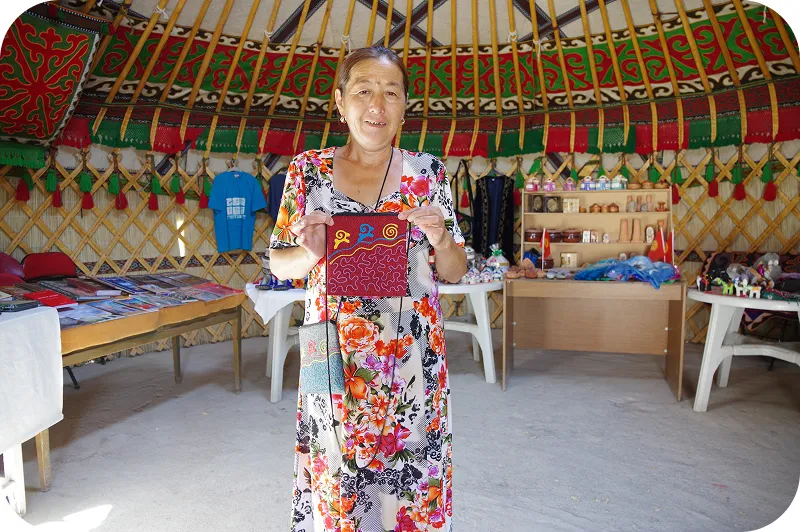
Head to a bazaar (market) and you’ll find shelves packed with fabric goods decorated with traditional embroidery called suzani.
- Cushion covers, bags, pouches and more, all with vivid, gorgeous decorations.
- They have the warmth of artisans’ handiwork, and at the bazaars you can buy them for much less than in Japan.
- There’s such a huge variety, and each piece is filled with the aesthetic sense of Uzbek people who like to beautifully decorate every space. They’re all so appealing that you’ll end up buying too much and thinking, “I’m going to go broke!”
Money and Payment Tips
- The currency is the som (UZS).
- As a rough guide as of 2025, 1,000 som is about 11 yen.
- Credit cards are accepted in more and more places in cities, but if you want to shop for bargains at the bazaars, have cash ready.
Preparing for Your Trip to Uzbekistan and Things to Note

To enjoy your trip with peace of mind, make sure to check local rules and etiquette.
Visa and Entry/Exit Rules
Japanese citizens are exempt from visas for stays of up to 30 days. Your passport must be valid for at least 3 months beyond your stay in Uzbekistan.
If you bring in foreign currency worth more than $2,000 when entering, you must declare it at customs. Also, artworks and crafts produced more than 50 years ago may require special permission to take out of the country, so be careful when shopping at the bazaars.
Safety and Photography
Uzbekistan is generally considered safe, but there are a few points travelers should keep in mind.
- Watch out for pickpockets and bag snatchers in crowded places such as bazaars and stations.
- When taking a taxi, it’s safest to confirm the price in advance or use a ride-hailing app.
- As mentioned above, drone regulations are strict even at tourist sites such as minarets, so don’t fly one carelessly.
Tips for Getting Around Town
- Foreigners are required to carry their passport and may be asked by police to show it (copies are not accepted).
- Many public toilets charge a fee, usually around 500 to 2,000 som per use.
- The voltage is 220V, and the standard plug is Type C with two round pins.
Rules may feel a little stricter than in Kyrgyzstan or Kazakhstan, but they’re there to protect travelers and keep order in the city. Enjoy interacting with the lively, business-savvy locals, follow the rules, and travel smart!
Set Off on a Vibrant Silk Road Journey

What I felt when I actually visited is that Uzbekistan is an energetic country, like “the Osaka of Central Asia.” There are lots of merchants, everything is brightly decorated, and it’s full of energy.
The rules are a bit stricter than in Kyrgyzstan, and you need to be careful with things like drone regulations, but the delicious plov (a UNESCO heritage dish) and the embroidered goods so cute you could go broke are something special. Shopping for bargains at the bazaars is truly fun.
Japanese citizens don’t need a visa for stays of up to 30 days. About 9 hours on a direct flight from Japan, and the adventure of a lifetime awaits!
Click here for the latest Uzbekistan articles and tours