




Salamatsyzby! This is Sugi from ASHU TRAVEL.
If you come to Uzbekistan, the one dish you absolutely must try is plov, the national dish.
But there are so many plov restaurants in Uzbekistan that on your first trip you’ll probably wonder, “Where should I eat?” and “What should I order?”
The place that answers all of those questions is the Plov Museum, a spot in Tashkent dedicated entirely to plov.
Here’s my report on eating, looking around, soaking up the atmosphere, and getting completely hooked on plov.
What is plov? Uzbekistan’s proud national food culture
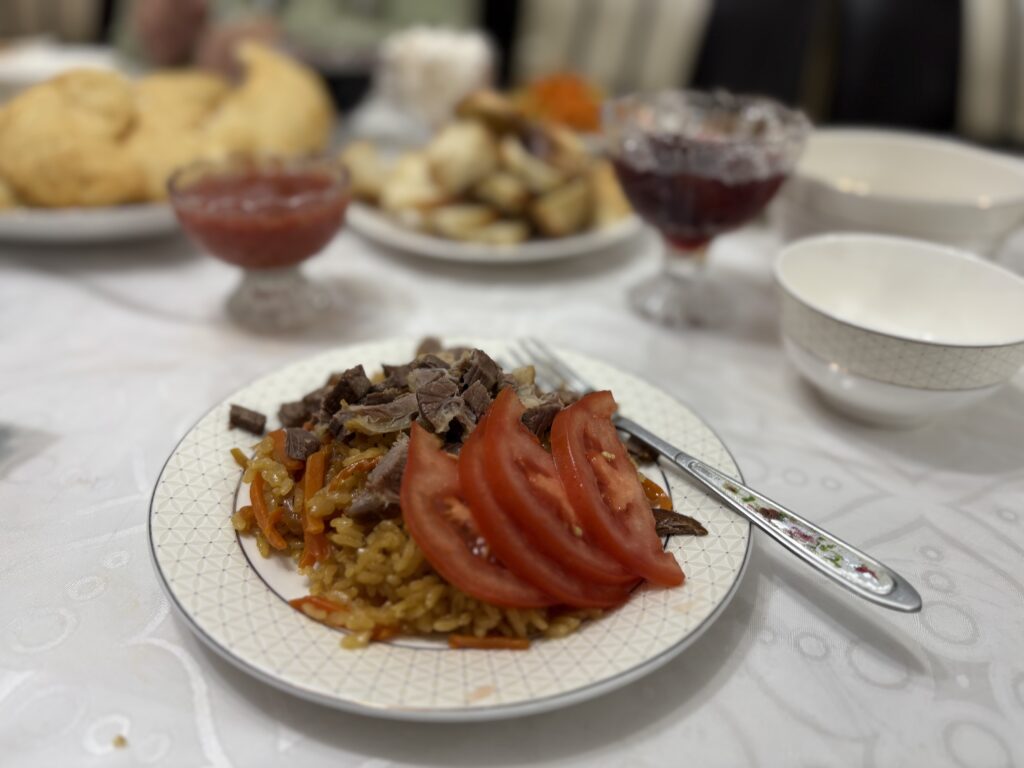
You can’t talk about Uzbek cuisine without plov. Let’s start with the basics.
A traditional Uzbek dish recognized by UNESCO

Plov is Uzbekistan’s national dish of rice, meat, carrots and spices cooked together in a huge cauldron.
The ingredients are simple, but the result is rich and complex. The skill of the cooks and the traditions of each region are packed into a single plate.
Its cultural value is recognized by UNESCO too: in 2016, “Palov culture and tradition” was inscribed as Intangible Cultural Heritage.
▶ Learn more about the UNESCO Intangible Cultural Heritage listing here (UNESCO)
Uzbek plov is in a league of its own

Plov actually isn’t unique to Uzbekistan. Kyrgyzstan and Kazakhstan have plov too, but the flavor is subtly different.
One of the reasons Uzbek plov is special is the size of the pot it’s cooked in.
Maybe it’s because it’s cooked in huge quantities in giant cauldrons up to 1–2 m across, but the flavor comes out deeper. It’s a bit like how curry tastes better when you make a big batch rather than a small one.
I love plov and eat it all the time in Central Asia, but I really do feel that Uzbek plov is in a league of its own. My friends and guides here say the same.
From weddings to funerals! Plov at the heart of daily life and culture

In Uzbekistan, plov isn’t just a traditional dish. Weddings, memorial services, family gatherings, national holidays: plov is served on every occasion.
Personally, I think plov is a very Uzbek dish. Uzbek people are warm and kind, they cherish their families, and they share all kinds of things with each other. To me, plov captures that Uzbek spirit.
What is the Plov Museum?

Now that you know more about plov, here’s a spot I recommend for anyone trying plov in Uzbekistan for the first time: the Plov Museum in Tashkent, the world’s only venue dedicated to plov.
It’s getting attention as a place where you don’t just eat, but experience Uzbek food with all five senses, through exhibits and watching the cooking.
Basic information (address, opening hours, access)

📍 Address: Катта Дархон 55, Tashkent
🕐 Opening hours: 11:00–23:00
📞 Reservations and delivery: +998 71 209 44 99
🌐 Official website: https://plove.uz/
📷 Instagram: @muzey.plova
Check the location and access on the map
A feast for the eyes too! My Plov Museum experience

I’ve been to the Plov Museum twice so far! Here’s what it’s actually like.
Step through the grand gate into the world of plov

Step through the grand, ancient-looking gate and you’ll find rows of carts and models of farm produce. You’re instantly drawn into the farming culture that gave birth to plov.
If you’re lucky, you’ll get a postcard

When I visited during Ramadan, there were Ramadan-related booklets and humorous postcards that you could take home for free. They were fun, with parts of famous paintings turned into plov.
They weren’t there on my first visit, so it may depend on timing. Lucky you if you find them!
A stream running through the building

A little stream flows through the building, and the moment you step inside it feels like another world. There’s terrace seating around the stream, which is apparently popular in summer (in winter it was far too cold, so no one was sitting there).
Kitchen viewing that changes throughout the day

In the kitchen downstairs, you can watch the chefs making nan and plov, smiling and waving at you.
What you can see depends on the time of day, so I recommend checking the schedule at the entrance.
So many varieties?! The rice display

Near the entrance there’s a display of the rice used for plov, with more than 8 varieties lined up. Different plovs have different textures and flavors because they use different kinds of rice.
Buy souvenirs at the mini bazaar

On the way to the restaurant there’s a mini bazaar. You can buy souvenirs like canned plov and compote made from dried fruit.
If you don’t have time to go to a bazaar, this is a good place to shop.
Enjoy the world of plov through the interior

In the lobby, you’ll find traditional Uzbek-style decor such as colorful tableware, mosaic tiles and chandeliers. The antique-style interior is Uzbek through and through.
You’ll enjoy the trip with your eyes as well as your stomach.
Tasting report! Comparing dishes at the Plov Museum

Once all that looking around has worked up an appetite, it’s finally time to eat. Everything we ordered was good. It was the perfect place for a first taste of Uzbek food.
Here’s what we ordered when four of us went.
Maysa salad

Light and easy to eat. However, the salad we ordered had cilantro in it, so if you don’t like cilantro, check before ordering.
Mastava (rice soup)

Personally, this was my favorite this time (and I mean even more than the plov, which is also delicious). It’s packed with the flavor of vegetables and meat, and adding yogurt to change up the taste makes it seriously addictive.
Tukhum barak (egg ravioli)

Our guide’s recommendation. It has a lovely chewy texture, and it’s a dish I’d never have discovered if I’d ordered on my own.
Lepyoshka (bread)

Uzbekistan’s classic nan. Perfect for a break between dishes.
Samarkand vs. Bukhara! A close comparison of two plovs

Finally, the main event. We shared and compared two kinds: Samarkand style and Bukhara style.
The Samarkand style has sweet carrots and a bit more oil, giving it a rich, hearty flavor that’s very filling.

The Bukhara style includes nuts and raisins and has a lighter finish.

Both have their own character and it’s hard to choose… but personally, Bukhara style wins!
Being able to experience the regional differences of Uzbek cuisine on a single plate is another great thing about the Plov Museum.
Achik-chuchuk (tomato and onion salad)

Put it on top of the rich plov and it refreshes your palate. The best partner for changing up the taste of your plov.
Drinks (lemon tea, compote)

For drinks, we ordered lemon tea and quince compote.
According to the Japanese-speaking guide who came with us, warm tea helps digestion with oily food. On the other hand, cold drinks combined with oil can upset your stomach, so be careful.
I don’t handle oily food very well, and in Japan I sometimes get an upset stomach after yakiniku (Japanese BBQ), but thanks to the warm, refreshing tea, I didn’t get a stomachache.
If it’s your first time trying Central Asian food, I hope this helps.
What we actually ordered and the prices (with yen conversion)

Here’s a summary of what we ordered and how much it cost. Feel free to use it for planning your trip.
*Calculated at 1 UZS ≈ ¥0.012 (approximate)
*Menu and prices as of February 2026. They may change.
| Dish | Local price (UZS) | Approx. in yen |
|---|---|---|
| Mastava (rice soup) | 58,000 | approx. ¥680 |
| Tukhum barak (egg ravioli) | 49,000 | approx. ¥580 |
| Maysa salad | 54,000 | approx. ¥635 |
| Samarkand-style plov “Shitra” | 96,000 | approx. ¥1,130 |
| Mashkhurda (mung bean soup) | 58,000 | approx. ¥680 |
| Lepyoshka (bread) | 11,000 | approx. ¥130 |
| Anzur (pickled mountain onion) | 24,000 | approx. ¥280 |
| Quince compote 1 L | 37,000 | approx. ¥435 |
| Lemon tea | 21,000 | approx. ¥250 |
| Bukhara-style plov “Oshi Sofi” | 96,000 | approx. ¥1,130 |
| Achik-chuchuk (tomato and onion salad) | 49,000 | approx. ¥580 |
It’s a little pricier than a typical restaurant in Tashkent, but for this atmosphere and quality, it’s well worth the money.
The meat has very little gamey smell, and everything we ordered was good. If you’re trying Uzbek food for the first time, this is the place I recommend most!
Great hospitality from the staff too

What stayed with me as much as the food was the warmth of the staff.
When we couldn’t decide what to order, they used gestures to tell us, “This one’s delicious,” “I recommend that one.” On both of my visits there were staff who spoke English, but maybe not all of them do.
If you come with a guide, they can tell you about the background of each dish, which takes the food experience to a whole new level.
Plov Museum FAQ

Here are the things you might want to know before you go.
Q. Do I need a reservation?

It’s not required, but since it’s a popular spot, a reservation is recommended.
You can book by phone (+998 71 209 44 99) or through the official website (plove.uz). Weekends and holidays tend to be especially busy, so contact them well in advance.
Q. Can I enjoy it without a Japanese-speaking guide?

There’s an English menu, so you can order on your own.
However, the staff mainly speak Uzbek and Russian, so with a guide you can get recommendations on dishes and the best way to eat them, and enjoy it more deeply.
Experience Uzbek food in depth for the first time with a guide by your side!
Q. Do I need to tip?

At the bottom of the receipt it said: “No service charge is added until 18:00. Additional tips for the waiter are at the guest’s discretion, but would be greatly appreciated.”
In other words, until 6 p.m. tipping is optional, and after 6 p.m. a service charge is added automatically, so you don’t need to tip.
Q. How is it different from cheap local plov restaurants?

Prices are higher than local plov places. But considering it’s an experience-style food spot that includes exhibits, atmosphere and quality food, I felt it was good value.
If it’s your first time eating plov, you can’t go wrong making the Plov Museum your first choice.
Get hooked on Uzbek food at the Plov Museum

The Plov Museum is perfect for experiencing Uzbek cuisine.
It’s a spot where you don’t just eat, but see, learn and literally soak up the atmosphere with your whole body.
Be sure to add it to your itinerary as one of the sights in Tashkent. It’s sure to make your trip even more satisfying!
ASHU guides who showed us around this time: Bahora and Armanzo

Bahora is a fluent Japanese-speaking Uzbek guide who also works as a Japanese teacher. From explaining the dishes to Uzbek culture and surprising connections with Japan, the conversation never runs out.
Armanzo (Japanese name: Kentaro) is Uzbek, with a Japanese-Sakhalin grandfather and a Kyrgyz mother. He speaks six languages and has an incredible knowledge of history. Even walking around the same places, you see them in a completely different way.
People often say a guide can change the quality of a trip, and that really was true.

ASHU TRAVEL offers trips around Central Asia, starting with Kyrgyzstan. A Japanese-speaking or English-speaking guide accompanies you, so there’s no need to worry about language. Meals, accommodation and transfers are all included, so even first-time visitors can travel with peace of mind.
For the latest updates and inquiries, reach us here!
▶︎ Instagram → @ashutravel_jp
▶︎ Ask us on our official LINE → Add us on LINE here



 Related Articles